What sort of people were these? What were they talking about? What office did they belong to?
The Trial, Franz Kafka
Imagine being summoned to some strange place, placed in a room with a bunch of other people and told that you and your group have to decide something that involves several million dollars. No background or other information.
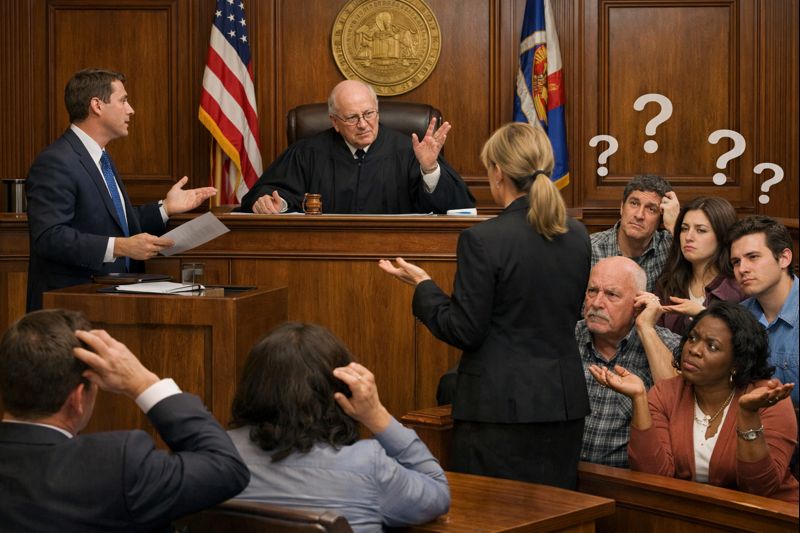
Your phone and computer are taken away. You’re told you have to make the decision based only on what you hear in the room and nothing else. Then you have some sort of lecture by a couple people in suits about what you are to decide. Each of those lectures is interrupted by discussions between them and some person who seems in charge you aren’t privy too. Followed by other individuals who provide information by answering question after question, many of which make little sense. And the question and answers are also interrupted by discussions with the guy in charge you can’t hear. Worse than that, some of the questions and answers are just read to you.
You’re sent home and told in no uncertain terms not to read anything or talk to anyone about this big decision. You come back the next day for more of the same. You still don’t know exactly what you are to decide. Your forbidden to ask any questions.
More lectures and interruptions. Finally, the person who seems to be in charge tells you here’s what and how you are to decide. But that is read to you in a monotone and is mostly incomprehensible. No further explanation and you aren’t allowed to ask questions to clarify what you don’t understand.
Then you’re then packed in a room with your group and told not to come out till you make the decision.
Sound dreadful? That, my friends, is a trial in today’s times.
That’s a Trial
I was a trial lawyer for many years but hadn’t been back in a courtroom for some time until recently when I had a chance to observe a civil trial. What I saw made me realize how far removed courtroom decision making by jurors is from how people make important decision “in real life”.
Indeed, the type and manner of information we provide to jurors has not changed much over the past 50 years, if not more. But the type of information, how we process it and how we learn is completely different than it was even 10 years ago much less 50.
Courtroom information is linear and confined. It’s based on lecture and testimony. But real world information is multimodal, individually directed and interactive. So when jurors come to the courtroom, they are adrift in some strange world that makes little sense to them and asked to decide something without the information and tools they usually use. Just as in my hypothetical, jurors are thrown into an foreign environment where they don’t know or understand the rules.
They are confined literally and figuratively to a small box while the trial goes on for hours. They are deprived of the sources they usually use for information. They are expected to grasp critical information through disjointed testimony, through questions and answers that make little sense. And the flow of the question and answers are often interrupted with objections and bench conferences.
And God help them when deposition testimony is read: is there anything more boring and harder to pay attention to?
Jurors are forced to absorb the information passively; they can’t ask questions most of the time, they can’t ask for more information to help them
Courtroom Learning is Passive
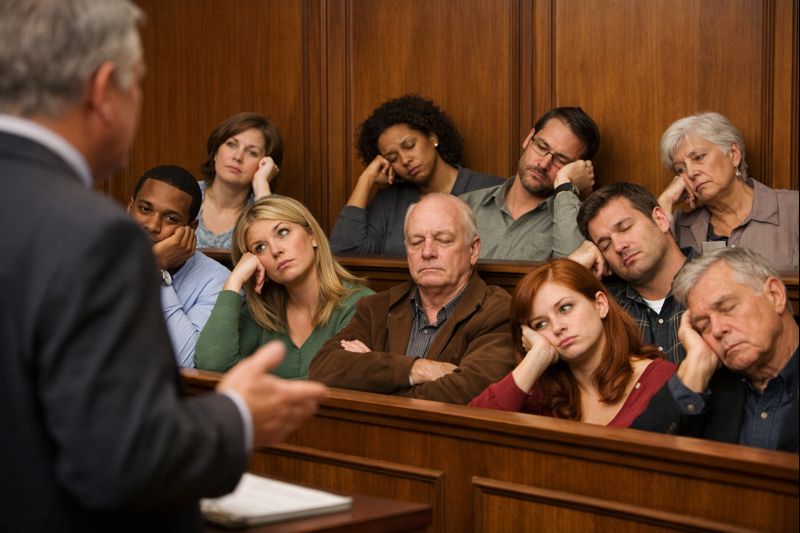
Jurors are forced to absorb the information passively; they can’t ask questions most of the time, they can’t ask for more information to help them. In many cases, they aren’t even allowed to take notes. They are expected to pay close attention to boring, monotonous, repetitive and hard to understand testimony and argument.
They lose patience and get frustrated making it even harder to pay attention.
At the conclusion of the testimony, the judge gives them instructions that are also incomprehensible. Very little is clothed in everyday language. Then they are locked away with people they don’t know and forced to make a decision.
How can we expect jurors to understand and process information that’s often complicated, when it’s presented is the dryest manner possible and in unusual and incomprehensible ways. How can we ask them to make the best decision possible with what they are given?
Worse still, courtroom proceedings every bit give the appearance of being for the benefit of the lawyers and the judge, not those who have the decision making responsibility
It’s a Matter of Respect
Worse still, courtroom proceedings every bit give the appearance of being for the benefit of the lawyers and the judge, not those who have the decision making responsibility. Jurors are told when to be there, where to sit and what to do. We demand that they give us their most valuable asset: their time, often at the expense of work and family responsibilities.
Yet, we force them to listen to lawyers drone on in opening and closing statements. They can’t raise their hand and ask questions. They can’t say can you repeat that. They can’t even say I didn’t hear what you just said. They are completely at the mercy of the lawyers and judges.
Real Life Decision Making
Let’s compare that to how we make decisions in real life. We get information from a variety of sources and in a variety of manners. We watch videos, we ask questions, more and more of GenAI platforms. And if we don’t understand what GenAI tells us, we can ask it to explain in a way we do understand. It’s interactive learning. It’s a process that matches our shorter attention span.
Think of it this way: what would you rather do: sit silently in a lecture or have a question and answer session—a dialogue if you will—with an expert?
What Can Be Done?
Of course, we have to realize and respect certain evidentiary and procedure trial protections that ensure decisions are as fair and valid as they can be. That is fundamental to our process. But that doesn’t mean we have no options to make things better: it all starts with attitude.
Most critically, we need to make the jurors the most important people in the room. We need to respect their time and make the process and testimony as concise and understandable as we can. We need to stop wasting their time with things that we don’t need them for, like sitting through bench conferences ad nauseam.
We need to ensure that when they are told to be in the courtroom at 9am, the trial and their role begins at 9am. Don’t make them sit for hours twiddling their thumbs while “important business” is conducted out of their earshot. We need to give them breaks every hour. We need to stop early, not stay late.
We need to come up with new ways of presenting evidence that is more consistent with how people get information and make decisions outside the courtroom.
Lawyer Responsibility
As lawyers, we need to understand that attention spans are short so let’s get our message across quickly and in understandable ways. We need to double down on making our evidence more interesting. We need to come up with new ways of presenting evidence that is more consistent with how people get information and make decisions outside the courtroom.
I help teach a trial technology persuasion class for lawyers where we help lawyers better use technology. I can’t begin to describe the improvements we see in storytelling and connecting with decision once lawyers master fundamental tech skills. We need more of this to make our presentations interesting and effective.
We need to be open to new ways to tell our stories as well. Early in my career, I was part of a trial team once where we made the decision to prepare an expensive video for use at trial. In those days, video storytelling techniques in the courtroom were unheard of. Yet we did it. And it was effective. We don’t have to keep doing things the same way.
Judicial Responsibility
The judiciary needs to play a role as well. Judges need to give potential jurors more information about the process and what to expect. They need to explain why things are done in the way they are. And judges also need to do this in interesting ways.
One of foremost experts on the use of technology in the courtroom, Judge Scott Schlegel recently talked about this in his Newsletter. He described how he used GenAI tools to create short videos for potential jurors, among other things. The topics include what happens when you get a jury notice, what should you bring to the courtroom, what happens if ou miss etc. Judge Schlegel says, “If we can create short videos that reduce confusion, missed appearances, unnecessary continuances and staff time spent answering the same basic questions, we improve real outcomes for real people.”
A New Way of Thinking
We need more of this kind of thinking. For example, we could require opening statements be done video where all the objections are taken out. We could work hard to eliminate objections and bench conferences generally. We can provide jurors with information about the dispute in advance so they understand what’s at stake. We need to take a hard look at the process and streamline that part of the process that involves a jury.
If we don’t? Our juries will no longer be juries of our peers but of a select group of people with nothing else to do or who are out of touch with the real world. And for those who otherwise do serve, they will come away with less respect for our time honored process and procedure and the rule of law itself.
It all starts with attitude and meeting jurors where they are today.