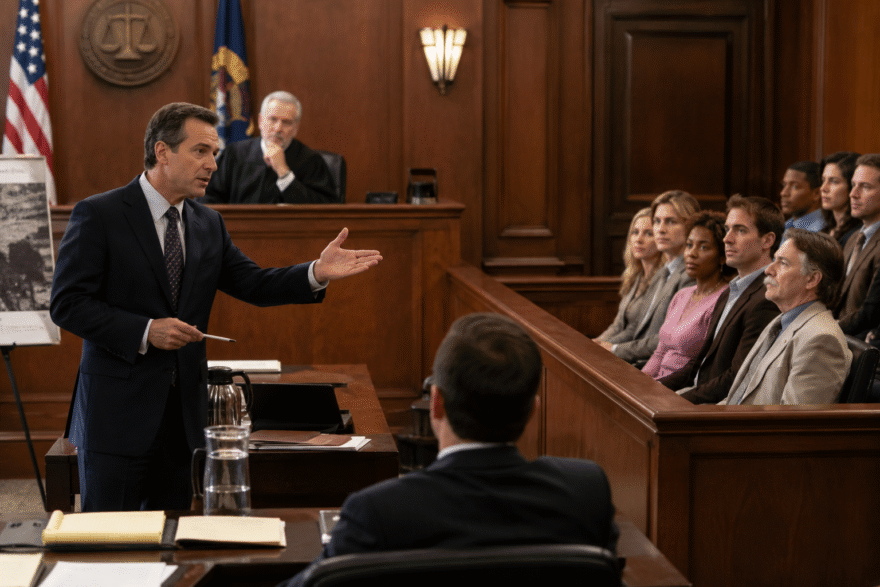
I recently finished reading one of Scott Turow’s legal thrillers. As most of you know, Turow is not only an author, but he was also a lawyer, and a trial lawyer at that. At one point in the book, he captured in a single paragraph what it’s really like to try cases. To be a trial lawyer. What he wrote resonated because it mirrored what I experienced and felt when trying cases over my career. And it’s not what you see on TV or even what you believe about other trial lawyers who you think are better at it.
Trials Are Hard
First of all, let’s fix facts. Trying cases is hard. It starts with intense preparation. In the days and weeks leading up to a trial, your anxiety level is over the top. You worry constantly. It involves a lot of sleepless nights, waking up in the middle of the night to jot some thoughts down. It requires poring over documents, thinking about tedious things like the introduction of evidence and admissibility, and constantly fretting if you are up to the task. I know. Been there, done that.
We all sweat bullets. Even Turow. Even me. It doesn’t matter how many cases you have tried
But what Turow confirmed so eloquently in a single paragraph is that every lawyer worth their salt goes through the same thing. We all worry beforehand. We are all anxious. We all sweat bullets. Even Turow. Even me. It doesn’t matter how many cases you have tried. Or won or lost.
When I was a young lawyer, I was on a trial team led by my mentor who was an experienced trial lawyer. I watched him in the courtroom. He was smooth, calm and collected. A few days before the trial, he told me that I would be examining one of the lesser witnesses. I was petrified. I figured I could never be as calm and polished as my mentor. But then he told something that tells you a lot about what all trial lawyers go through.
He said, “Steve, there’s no reason you shouldn’t have to run to the bathroom five times right before trial like the rest of us.” The bottom line is that fear and even loathing about a trial goes with the territory. There’s no way around it. You never get over it.
The Never Ending Worry Loop

And as Turow points out, it doesn’t stop once the trial starts. The reality is when you come home at night after a day in the courtroom, you fret endlessly about what happened that day. You worry about questions you asked or didn’t ask. Objections you made or didn’t make. You wonder if your demeanor was right. Whether you looked confident or scared shitless. Whether your body language was what it should be. You even question whether you smiled at the jury enough. And you convince yourself each and every one of these things is going to change the outcome.
But most of that worry about details is wasted. You can’t do anything about what happened that day. It’s like missing a shot or missing a putt: the best thing you can do is just forget it and keep playing.
There’s an old adage: people may not remember what you say. But they will remember how you made them feel
And all that worry is too focused on the trees instead of the forest. The critical thing is the story you are telling. The question is not “Should I have objected?” but “is what I am doing consistent with the story I’m telling?” It’s about how well your story resonates. There’s an old adage: people may not remember what you say. But they will remember how you made them feel. That’s what good stories do.
That’s the courtroom. That’s life, by the way.
There’s One Thing You Can Never Change
And remember too the one thing you can’t do is change the facts. You can only control how you present them. The reality is if you try cases, you are going to lose some. Cases that you thought you should win. Get over it.
I tried a large case once for which I reported to an insurance adjuster who had been through many more trials than I had. I lost the case. As I trudged back to the hotel, I dreaded calling her and telling her we had gone down in flames. I assumed her reaction would be one of anger. That she would immediately question my ability. But when I told her we had lost, she just shrugged and said, “That’s what happens when you try cases.” Indeed.
I’ve always snickered at those lawyers who say, “I’ve tried lots of cases and haven’t lost one yet.” My response, most but not always under my breath, is if you’ve never lost a trial, you haven’t tried enough cases. You can’t win every one.
Why We Do What We Do
I will be honest; I never loved trying cases. In fact, I dreaded them. So why did I or anyone else ever want to do it? It’s simple: once the trial starts and you stand at the podium to give your opening statement, everything else drops away. The rest of the world vanishes. The fear vanishes. The questioning of your ability vanishes, at least till you go home at night. Your focus is singularly on what happens in the courtroom.
There are almost no other places in our lives requiring this kind of focus and concentration. It makes us feel alive.
It’s that singular focus that draws lawyers to try cases. It’s one of the few times where, as Turow put it, we use all of our human abilities on trying to achieve one thing. There are almost no other places in our lives requiring this kind of focus and concentration. It makes us feel alive.
Now My Podium Is My Laptop
I no longer try cases. Instead, I write about legal technology and innovation. One thing I have discovered is that, at least on a small scale, writing is like the courtroom. I get up in the morning, dreading that I’ve got to write an article that’s due. Not knowing exactly what I am going to say. I think about it. I worry about it. I wake up in the middle of the night playing it out in my head.
But when I sit down and start to write, the rest of the world fades. It’s just me and my laptop. For that couple of hours at least, I get that familiar feeling of concentration, of being alive and of actually creating something. Day-to-day humdrums and worries vanish at least for a little while. That’s why I do what I do. Even still. But these days I worry whether we will continue to have that chance to so singulary focus.
Today’s Worry Is Different
We now live in a world where AI makes everything so much easier and simpler. Want to know whether to make an objection in the courtroom? Ask Gemini. Want to know what or whether to ask a witness something? Ask Harvey. Want to write an article? Just tell ChatGPT to do it, and it will.
Much of the work that we dreaded and sweated over becomes easy. Too easy. It requires less concentration. It requires less judgment and creativity. But something is lost in the process. It’s that concentration and that required focus in the courtroom and, for that matter, when I draft articles that make the doing worthwhile. That makes it fulfilling.

If AI tells the story, it’s no longer our story
If AI ends up eliminating that high we get in the courtroom or at our laptop, we may no longer want to go through the hell to get there. And our product will assuredly go downhill. That’s because we’re not exercising the part of us that makes us human. That’s the ability to reach people, to communicate with them, and to touch them in some way. If AI tells the story, it’s no longer our story.
That is the essence of being a good trial lawyer and a good writer. It is why we go through what we go through. It’s what makes us human. Let’s not delegate that to AI. No matter how tempting.