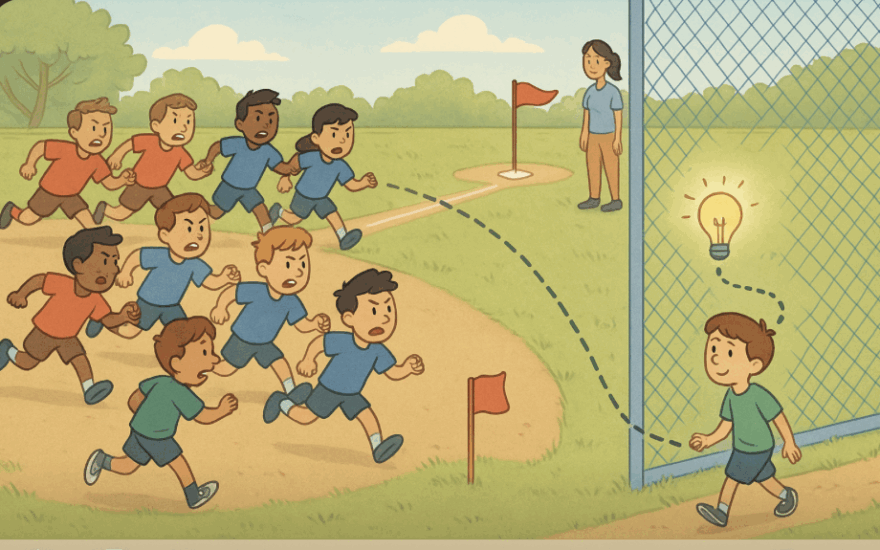
The grade school game seemed simple enough. Grab the other team’s flag without getting tagged. But for a kid like me with not much athletic talent, the chances of being a factor other than getting quickly tagged out were pretty remote. Or so it seemed.
One of the questions I am often asked by young lawyers is how I get to where you are and develop a successful practice and career.
It All Started With Capture the Flag
I tell them it all started with Capture the Flag. For the uninitiated, Capture the Flag is a school yard game where the playing area is divided into two territories. Each team has a flag placed somewhere within their side of the field. Players try to grab the flag but if they cross into the other side’s territory they can be tagged and are out. To win you have to get the flag.
The game seems a little illogical since winning requires the sacrifice of enough players to cross the line and get tagged until there are so few left that you can successfully avoid being tagged and get the flag. It’s a brute force kind of thing.
Let’s Play
Or so it seemed. I was in grade school and the teacher decided today’s game would be Capture the Flag. She explained the above rules to us, blew her whistle, and play commenced.
Now you need to understand the configuration of this particular area. We were playing on a baseball diamond with the line between the two teams running along a line from first to third base. The opposing team’s flag was placed roughly at home plate. The diamond was surrounded on two sides by a protective fence typical of most baseball diamonds. There was an opening that allowed access to the field itself.
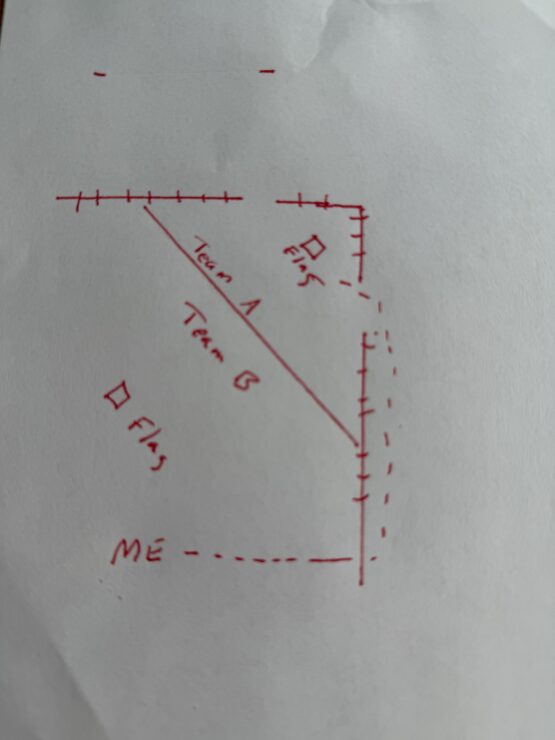
Here’s a diagram. I was on Team B.
Now as I said, I wasn’t the world’s greatest athlete so I was toward the back of our team flag. But I’m looking at this and it occurs to me that charging directly into enemy territory was hopeless. Too many bodies between the line and the flag.
But then I saw it
But then I saw it: a path on the outside of the fence would enable me to get behind the mass of bodies and grab the flag if undetected. The broken line shows my path.
And it worked like a charm, slipped in, grabbed the flag and ran back with it much to everyone’s amazement. Of course the other side complained that I had broken the rules, to which the teacher explained I never said you had to stay on this side of the fence (to her credit by the way).
So What’s the Point?
So you’re wondering what’s the point of the game and the relationship to my career. The point is that incident taught me a valuable lesson. You don’t always, if ever, have to follow conventional wisdom about how to solve problems. The best solutions are those that are outside of the conventional wisdom, that go around a problem in a new way. Stay within the rules, yes. But use them to your advantage.
I have used that lesson when I needed to change my career path and develop a national practice from a smaller city. When I needed to change my practice specialty. When I made pitches to clients. When I thought of a new way of billing for a matter to solve the predictability problems of a client. When I came up with solutions to client problems and thorny cases. When we came up with new ways to tell the story and define what a case was about. Even when I made the shift from full time practice to writing and blogging.
Not all crazy ideas are great but all great ideas are crazy
Some might call this some kind of unique gift. But I don’t think so. I think it’s about staying open to new approaches. To being flexible and nimble. As Mike Posner put it, “Not all crazy ideas are great but all great ideas are crazy”.
And thinking about the problem first. As Albert Einstein, also a guy with little athletic talent but who did alright for himself, advised: “If I had an hour to solve a problem, I would spend most of the time thinking about the problem and only a small part working on the solution.”
Another way to think about it: I once had a professor who was fond of saying, ‘the problem…is the problem.” What he meant was that defining the problem—how to somehow get to the flag without running the gauntlet of people in the way—is often the key to the solution.
But We Have ChatGPT Now
I think this is more true today than ever.
I was once asked at a presentation if I thought a GenAI tool could ever write like Ernest Hemingway. I thought for a minute and said, maybe. But I’m not sure it will ever write like the next Ernest Hemingway. Hemingway’s style and voice at the time was original and new. A GenAI tool, had it existed at the time, would not have found a similar style because it didn’t exist.
So it is with innovative solutions to problems. To get there, you have to think about the problem and look for a solution that hasn’t been developed yet. That involves critical thinking. I have written before on the dangers of using GenAI to shortcut critical thinking. Indeed, an oft cited 2025 Study by Michael Gerlich found, as Stephen Klein of Curiouser.Ai put it, “AI usafe is inversely correated with critical thinking…The more we use it, the less we think.”
Can a GenAI tool help? Maybe. But can it be innovative on its own? I’m not sure, at least not yet.
What Would ChatGPT Do?
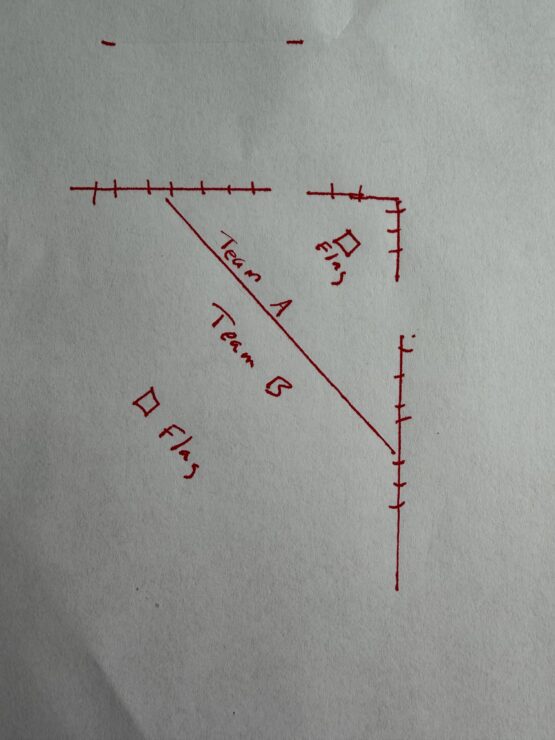
I gave this Capture the Flag diagram to ChatGPT and pointed out that the area was in a baseball diamond surrounded by a fence and asked it the best strategy for team B to capture the flag. It gave a long answer starting with the observation, “Team B must approach the flag through a narrow, easily defended zone because the fence limits access.” It also said don’t bunch near the fence since that would create a trap.
Never did it consider what my 5th grade brain figured out: go outside the fence and around the back side. Why? Because like the conventional thinkers in the game, it didn’t consider that option and assumed players couldn’t go outside the fence.
I know some would say I didn’t give it enough of a prompt to figure that out and maybe so. But lots of us fall down on prompts because we don’t critically think about the problem first. We don’t define the problem first. We assume limitations that aren’t there.
That changes the entire game
Using ChatGPT to Help, Not Think
Of course, when I told ChatGPT that no one said we had to stay within the fence but everyone assumed we had to, it found the strategy: “That changes the entire game. If the fence is assumed to be a boundary but is not actually a rule, then the openings shown on your diagram create secret escape routes. Almost everyone will keep playing as if the fence is a wall. That gives Team B a hidden advantage.”
Want to do great things? Think differently. Go outside convention. Change the entire game.
It starts with looking at the problem and for innovative ways to capture whatever flag you’re after.